 Add to Chrome
 Add to Firefox
 Add to Edge
BAGEN: Are LLM Agents Budget-Aware?
May 29, 2026
While agents are increasingly spending more resources, today agent cost is mostly measured only after execution. A Budget-Aware Agent (BAGEN) should treat budget as an active control signal, rather than a passive cost metric. We first systematically define budget estimation as internal budgets (from agent computation) and external budgets (from agent actions). We then formalize budget-awareness as progressive interval estimation: at each step of a plan, an agent should predict an upper and lower bound on remaining budget, and alert when completion is unlikely. Scoring with a rollout-replay protocol, we find consistent failure patterns on four environments and five frontier agents: (1) strong agents do not necessarily have strong budget-awareness, with correlation r=0.35. (2) frontier models are consistently over-optimistic, continue spending on tasks that are unlikely to succeed, instead of alerting the user early. (3) budget-aware signal is actionable and trainable. Early stop saves 28-64% tokens on failed trajectories, and SFT+RL strengthens early stop and alert behavior. (4) precise interval calibration remains challenging, with interval coverage capping at 47% after SFT+RL. Project page: https://ragen-ai.github.io/bagen/

Knowing but Not Showing: LLMs Recognize Ambiguity but Rarely Ask Clarifying Questions
May 24, 2026User queries are often underspecified and may admit multiple valid interpretations. Rather than silently making assumptions about the user's intent, a helpful assistant should surface such ambiguity by asking a clarifying question. Doing so requires two abilities: recognizing that a query is ambiguous, and acting on that recognition by seeking clarification instead of answering directly. To study these abilities, we evaluate models on ambiguous, unambiguous, and disambiguated questions in three settings: standard question answering, explicit ambiguity judgment, and behavioral analysis, where a judge model classifies responses as direct answers, refusals, or clarifying questions. We find a clear gap between recognition and behavior: models often identify ambiguity when explicitly asked to judge it, yet in the QA setting they overwhelmingly default to direct answers. Retrieved context further widens this gap by improving answerability while making models even less likely to ask clarifying questions.
Clarification Is Not Enough: Post-Clarification Answering Remains the Bottleneck in Multi-Turn QA
May 24, 2026Pluralistic alignment requires systems to adapt to diverse user values, communication styles, and contextual assumptions. We believe that a foundational prerequisite for such alignment enabling accurate preference elicitation from people when their intent is under-specified or ambiguous. We study the problem of preference elicitation in multi-turn question answering by decomposing the problem into two components: a \textbf{clarification policy}, which decides whether to ask a clarifying question or answer directly, and \textbf{post-clarification answering}, which produces the correct final answer once the missing information is provided. We show, using the PACIFIC benchmark, that supervised fine-tuning rapidly improves the clarification policy, however, final answer accuracy remains substantially lower even when the model takes the correct action. This gap indicates that understanding and correctly interpreting the user's response is the critical gap in multi-turn question-answering systems.
FIRE-Bench: Evaluating Agents on the Rediscovery of Scientific Insights
Feb 02, 2026Autonomous agents powered by large language models (LLMs) promise to accelerate scientific discovery end-to-end, but rigorously evaluating their capacity for verifiable discovery remains a central challenge. Existing benchmarks face a trade-off: they either heavily rely on LLM-as-judge evaluations of automatically generated research outputs or optimize convenient yet isolated performance metrics that provide coarse proxies for scientific insight. To address this gap, we introduce FIRE-Bench (Full-cycle Insight Rediscovery Evaluation), a benchmark that evaluates agents through the rediscovery of established findings from recent, high-impact machine learning research. Agents are given only a high-level research question extracted from a published, verified study and must autonomously explore ideas, design experiments, implement code, execute their plans, and derive conclusions supported by empirical evidence. We evaluate a range of state-of-the-art agents with frontier LLMs backbones like gpt-5 on FIRE-Bench. Our results show that full-cycle scientific research remains challenging for current agent systems: even the strongest agents achieve limited rediscovery success (<50 F1), exhibit high variance across runs, and display recurring failure modes in experimental design, execution, and evidence-based reasoning. FIRE-Bench provides a rigorous and diagnostic framework for measuring progress toward reliable agent-driven scientific discovery.
The Illusion of Specialization: Unveiling the Domain-Invariant "Standing Committee" in Mixture-of-Experts Models
Jan 06, 2026Mixture of Experts models are widely assumed to achieve domain specialization through sparse routing. In this work, we question this assumption by introducing COMMITTEEAUDIT, a post hoc framework that analyzes routing behavior at the level of expert groups rather than individual experts. Across three representative models and the MMLU benchmark, we uncover a domain-invariant Standing Committee. This is a compact coalition of routed experts that consistently captures the majority of routing mass across domains, layers, and routing budgets, even when architectures already include shared experts. Qualitative analysis further shows that Standing Committees anchor reasoning structure and syntax, while peripheral experts handle domain-specific knowledge. These findings reveal a strong structural bias toward centralized computation, suggesting that specialization in Mixture of Experts models is far less pervasive than commonly believed. This inherent bias also indicates that current training objectives, such as load-balancing losses that enforce uniform expert utilization, may be working against the model's natural optimization path, thereby limiting training efficiency and performance.
Thinking Fast and Right: Balancing Accuracy and Reasoning Length with Adaptive Rewards
May 23, 2025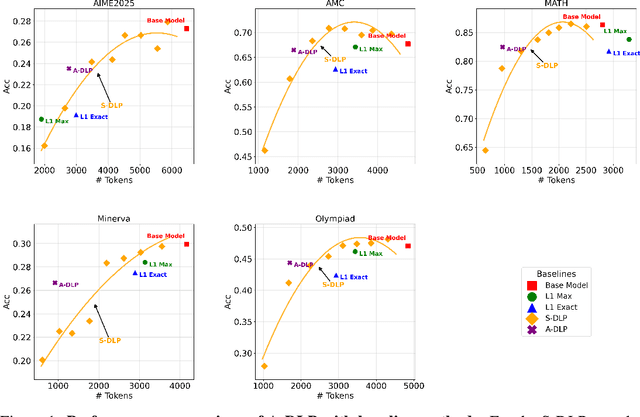
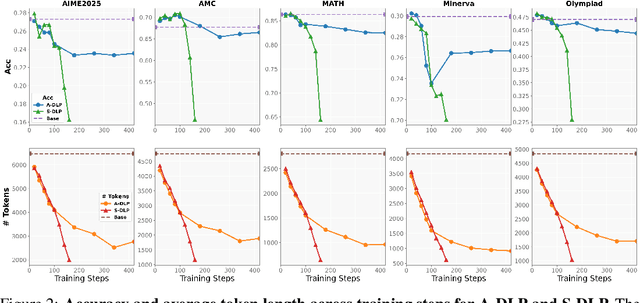
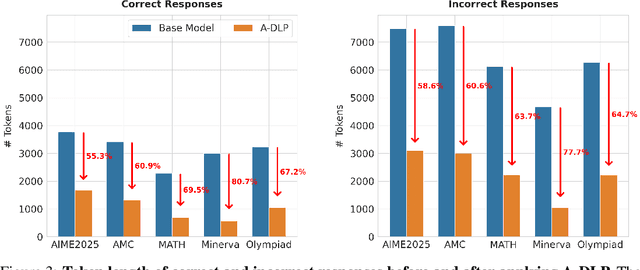
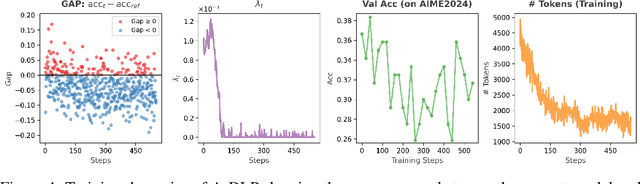
Large language models (LLMs) have demonstrated strong reasoning abilities in mathematical tasks, often enhanced through reinforcement learning (RL). However, RL-trained models frequently produce unnecessarily long reasoning traces -- even for simple queries -- leading to increased inference costs and latency. While recent approaches attempt to control verbosity by adding length penalties to the reward function, these methods rely on fixed penalty terms that are hard to tune and cannot adapt as the model's reasoning capability evolves, limiting their effectiveness. In this work, we propose an adaptive reward-shaping method that enables LLMs to "think fast and right" -- producing concise outputs without sacrificing correctness. Our method dynamically adjusts the reward trade-off between accuracy and response length based on model performance: when accuracy is high, the length penalty increases to encourage faster length reduction; when accuracy drops, the penalty is relaxed to preserve correctness. This adaptive reward accelerates early-stage length reduction while avoiding over-compression in later stages. Experiments across multiple datasets show that our approach consistently and dramatically reduces reasoning length while largely maintaining accuracy, offering a new direction for cost-efficient adaptive reasoning in large-scale language models.
Between Underthinking and Overthinking: An Empirical Study of Reasoning Length and correctness in LLMs
Apr 30, 2025Large language models (LLMs) are increasingly optimized for long reasoning, under the assumption that more reasoning leads to better performance. However, emerging evidence suggests that longer responses can sometimes degrade accuracy rather than improve it. In this paper, we conduct a systematic empirical study of the relationship between reasoning length and answer correctness. We find that LLMs tend to overthink simple problems, generating unnecessarily long outputs, and underthink harder ones, failing to extend their reasoning when it is most needed. This indicates that models might misjudge problem difficulty and fail to calibrate their response length appropriately. Furthermore, we investigate the effects of length reduction with a preference optimization algorithm when simply preferring the shorter responses regardless of answer correctness. Experiments show that the generation length can be significantly reduced while maintaining acceptable accuracy. Our findings highlight generation length as a meaningful signal for reasoning behavior and motivate further exploration into LLMs' self-awareness in reasoning length adaptation.
Fast or Better? Balancing Accuracy and Cost in Retrieval-Augmented Generation with Flexible User Control
Feb 17, 2025Retrieval-Augmented Generation (RAG) has emerged as a powerful approach to mitigate large language model (LLM) hallucinations by incorporating external knowledge retrieval. However, existing RAG frameworks often apply retrieval indiscriminately,leading to inefficiencies-over-retrieving when unnecessary or failing to retrieve iteratively when required for complex reasoning. Recent adaptive retrieval strategies, though adaptively navigates these retrieval strategies, predict only based on query complexity and lacks user-driven flexibility, making them infeasible for diverse user application needs. In this paper, we introduce a novel user-controllable RAG framework that enables dynamic adjustment of the accuracy-cost trade-off. Our approach leverages two classifiers: one trained to prioritize accuracy and another to prioritize retrieval efficiency. Via an interpretable control parameter $\alpha$, users can seamlessly navigate between minimal-cost retrieval and high-accuracy retrieval based on their specific requirements. We empirically demonstrate that our approach effectively balances accuracy, retrieval cost, and user controllability, making it a practical and adaptable solution for real-world applications.
Is Human-Like Text Liked by Humans? Multilingual Human Detection and Preference Against AI
Feb 17, 2025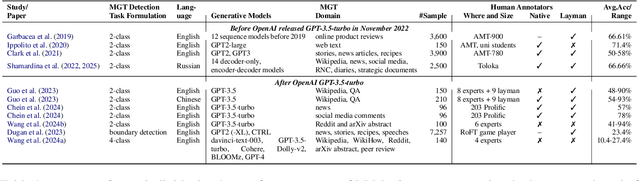
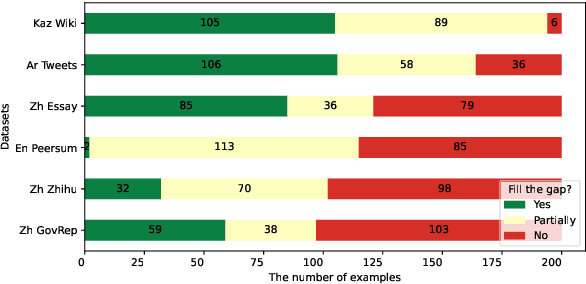
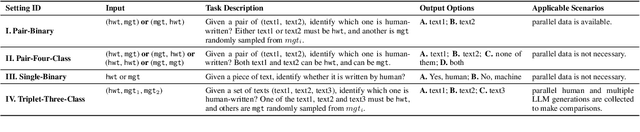
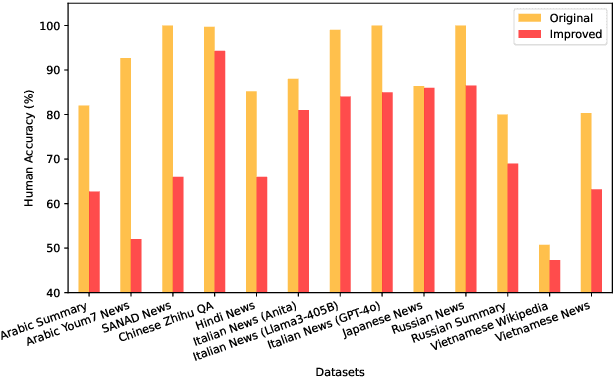
Prior studies have shown that distinguishing text generated by large language models (LLMs) from human-written one is highly challenging, and often no better than random guessing. To verify the generalizability of this finding across languages and domains, we perform an extensive case study to identify the upper bound of human detection accuracy. Across 16 datasets covering 9 languages and 9 domains, 19 annotators achieved an average detection accuracy of 87.6%, thus challenging previous conclusions. We find that major gaps between human and machine text lie in concreteness, cultural nuances, and diversity. Prompting by explicitly explaining the distinctions in the prompts can partially bridge the gaps in over 50% of the cases. However, we also find that humans do not always prefer human-written text, particularly when they cannot clearly identify its source.
Towards More Robust Retrieval-Augmented Generation: Evaluating RAG Under Adversarial Poisoning Attacks
Dec 21, 2024Retrieval-Augmented Generation (RAG) systems have emerged as a promising solution to mitigate LLM hallucinations and enhance their performance in knowledge-intensive domains. However, these systems are vulnerable to adversarial poisoning attacks, where malicious passages injected into retrieval databases can mislead the model into generating factually incorrect outputs. In this paper, we investigate both the retrieval and the generation components of RAG systems to understand how to enhance their robustness against such attacks. From the retrieval perspective, we analyze why and how the adversarial contexts are retrieved and assess how the quality of the retrieved passages impacts downstream generation. From a generation perspective, we evaluate whether LLMs' advanced critical thinking and internal knowledge capabilities can be leveraged to mitigate the impact of adversarial contexts, i.e., using skeptical prompting as a self-defense mechanism. Our experiments and findings provide actionable insights into designing safer and more resilient retrieval-augmented frameworks, paving the way for their reliable deployment in real-world applications.